
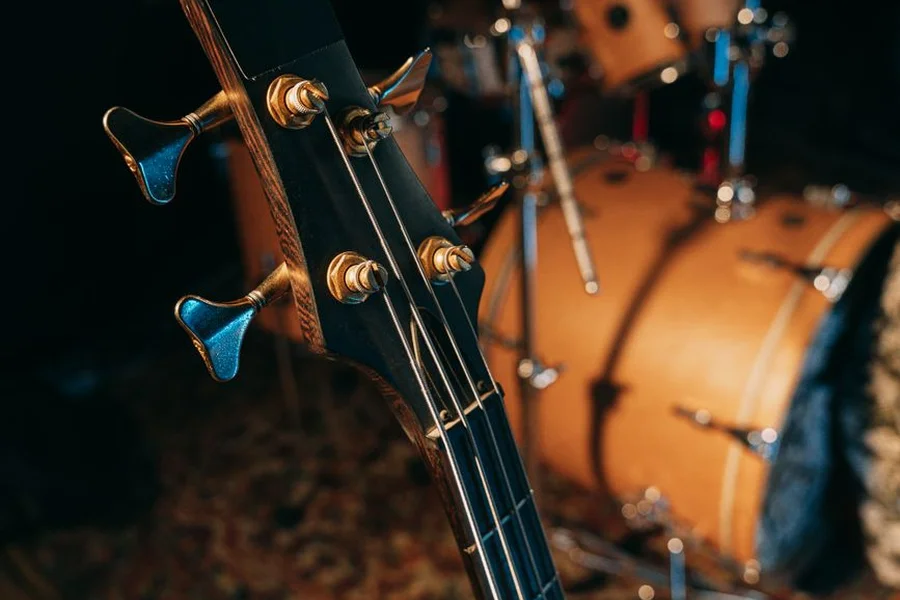
If you have ever picked up a Peavey T-40 bass guitar, the first thing you noticed was likely its sheer weight. Built during an era when heavy wood meant sustained tone, this American classic has earned a dedicated following among players who appreciate rock-solid craftsmanship and flexible tone controls.
Produced between 1978 and 1988 in Meridian, Mississippi, the T-40 stands out as a high-value instrument with a distinct personality. Whether you are looking to buy your first vintage bass or trying to figure out how its tone knobs work, this guide covers everything you need to know. Playing a heavy instrument like this requires a dedicated rehearsal space. Many musicians set up their music rooms in a backyard outdoor office pod to practice at high volumes without disrupting the main house.
Table of Contents
Why Is the Peavey T-40 Bass Guitar a Vintage Classic?
The Peavey T-40 is a vintage classic because it brought precision CNC computer manufacturing to guitar production while offering tone options that rivaled far more expensive instruments. Company founder Hartley Peavey designed it to give working musicians high quality without high price tags.
During the late 1970s, most major guitar makers were still hand-shaping wood necks, which often led to inconsistencies. Peavey changed the market by using computer-controlled routers to carve necks with exact tolerances. This allowed them to produce straight, comfortable maple necks at a fraction of the traditional cost.
Many musicians who perform live at major events or travel for shows rely on sturdy gear that holds up under pressure. Just as organizers plan smooth transport for large events, like a concert experience shuttle service, bass players in the 1980s trusted the T-40 for its indestructible build quality.
Peavey T-40 Specifications and Build Quality
The Peavey T-40 features a solid ash or poplar body, a 34-inch scale neck, and dual humbucking pickups paired with die-cast hardware. It was designed from the ground up to handle decades of heavy stage use.
Here is a breakdown of the key physical specifications:
- Body Material: Solid Northern hard ash or dense poplar with a carved top.
- Neck & Fingerboard: Hard rock maple neck with 20 frets and a 34-inch scale length.
- Pickups: Two passive blade-style “toaster” humbuckers designed by Peavey.
- Bridge: Heavy die-cast chrome bridge with individual saddles and string-through-body loading.
- Nut Width: Standard 1.68 inches (approx 43 mm), giving it a solid feel similar to a Precision bass.
How Does the Peavey T-40 Tone Knob Trick Work?
The Peavey T-40 tone knob trick works by using a unique variable coil-splitting circuit patented under U.S. Patent 4,164,163. When you turn the tone knob between 10 and 7, the circuit gradually splits the pickup from a full humbucker into a single coil.
Unlike standard tone controls that only roll off high frequencies, Peavey designed a dual-function potentiometer circuit:
- Settings 10 to 7: Turning the tone knob from 10 down to 7 cuts out one coil of the humbucker. At 7, the pickup operates fully as a crisp single-coil pickup.
- Settings 7 to 0: Rolling the knob below 7 turns it into a standard treble-cut control, darkening the sound just like a traditional bass tone knob.
Because each pickup has its own tone control, you can set the neck pickup to single-coil mode while keeping the bridge pickup in full humbucking mode. This gives players a wider variety of tones than most vintage passive basses offer. You can find detailed circuit breakdowns on gear sites like Seymour Duncan.
What Is the Phase Switch on a Peavey T-40?
The phase switch on a Peavey T-40 is a two-position mini-toggle that reverses the electrical phase of the bridge pickup when both pickups are active. It produces a hollow, mid-scooped sound often described as a “nasal” or funk-style tone.
One common point of confusion for new owners is when the phase switch appears to do nothing. In a stock factory circuit, the phase switch only functions when the main pickup selector toggle is in the middle position (both pickups selected). If you select only the neck or only the bridge pickup, flipping the phase switch will not change your sound at all.
From what we’ve seen while testing vintage units, if the phase switch changes tone while only one pickup is selected, someone likely modified the wiring in the past.
Why Is the Peavey T-40 So Heavy?
The Peavey T-40 is so heavy because Peavey used dense Northern hard ash for the body alongside oversized die-cast zinc hardware. Most T-40 basses weigh between 10.5 and 12 pounds (4.7 to 5.4 kg).
In the late 1970s, guitar designers believed that heavier wood created longer sustain and fuller low-end response. While the sustain on a T-40 is exceptional, standing with one for a three-hour gig can strain your neck and shoulder.
Imagine you are preparing for a long weekend show. If you strap on a 11.5-pound T-40 with a thin nylon strap, you will feel shoulder fatigue within 20 minutes. One practical suggestion we recommend is pairing this bass with a wide, 3.5-inch padded leather strap or an ergonomic double strap to distribute the weight evenly across your back.
How Much Does a Peavey T-40 Bass Cost Today?
A Peavey T-40 bass currently costs between $500 and $900 on the used market, depending on finish condition, hardware wear, and whether the original molded hardshell case is included. Rare finishes like natural sunburst or pristine natural ash often sell toward the higher end of that range.
According to 2025 sales data from online gear marketplaces like Reverb, prices for T-40 basses have risen steadily over the past five years. They were once considered cheap budget finds under $300, but players have recognized their build quality, driving up demand.
We prefer buying units that still have their original potted pickups and un-modified wiring harnesses. Replacing original pots on a T-40 can be tricky because standard modern pots do not feature the specialized dual-taper sweep required for the coil-split feature.
Frequently Asked Questions About the Peavey T-40
Are Peavey T-40 basses made in the USA?
Yes, all original Peavey T-40 basses were manufactured in Meridian, Mississippi, USA, between 1978 and 1988.
What year was the Peavey T-40 produced?
Peavey introduced the T-40 bass in 1978 alongside the T-60 electric guitar. Production ran until 1988, when Peavey updated its bass lineup with lighter models.
Can you use active electronics in a Peavey T-40?
Yes, you can install active preamps, but doing so usually requires modifying the original wiring harness. Most players keep the stock passive system to preserve its unique coil-split capability.
What scale length is the Peavey T-40 bass?
The Peavey T-40 has a standard long-scale length of 34 inches with 20 frets.
How do you fix scratchy tone pots on a vintage T-40?
Scratchy controls on a vintage T-40 are usually caused by dust and oxidation inside the potentiometers. Spraying contact cleaner directly into the pot casing and turning the knob back and forth usually restores clean operation without needing replacement parts.

Written by Rosella
Rosella is a self-taught digital creator with a passion for breaking down tech, lifestyle, and everyday topics into simple, easy-to-understand content. Based in Youngstown, Ohio, she brings a curious, multi-disciplinary approach to writing, covering everything from the latest tech trends to practical life hacks and personal growth insights.
Her goal is straightforward: take complicated ideas and explain them in a way that actually makes sense, so every reader, whether a total beginner or someone more experienced, walks away having learned something useful. When she’s not writing, you’ll usually find her exploring new tools, sharpening her skills, or spending time with family.
Through this blog, Rosella aims to build a community centered on real, actionable insights rather than fluff, jargon, or filler content.